

If you've given your dog CBD and noticed very little — or nothing at all — the product format is often the first thing worth examining. Most pet owners who come away disappointed focus on the dose, the brand, or how long they gave it. Few look at whether the product was a full spectrum hemp extract or a CBD isolate. That distinction, it turns out, has more influence on outcomes than almost any other variable. And the research behind it is more developed than most people realize.
This article breaks down what CBD isolate actually is, why the science suggests it's the less effective format, and what full spectrum hemp contains that isolate does not. It's part of a broader series on understanding why CBD doesn't always work for dogs — and how to approach it more effectively.
- What CBD Isolate Actually Is
- What Full Spectrum Hemp Actually Contains
- The Dose-Response Problem With Isolate
- Why "Cheap CBD" Is Usually an Isolate Problem
- The THC Question in Full Spectrum Products
- How to Know What Format You're Actually Buying
- What the Research Suggests as a Starting Point
- Frequently Asked Questions
Related product



What CBD Isolate Actually Is
CBD isolate is exactly what the name suggests: cannabidiol that has been extracted and then isolated from all other compounds in the hemp plant. The result is a white powder or crystalline substance that is, in its purified form, 99% or greater CBD — with nothing else present. No other cannabinoids. No terpenes. No flavonoids. A single molecule.
This sounds appealing on paper. Pure CBD, clearly defined, no unknowns. For a period, isolate was marketed as the premium option precisely because of this purity — the logic being that more CBD, in its clearest form, would mean more benefit. The research has since pointed in a different direction.
What Full Spectrum Hemp Actually Contains
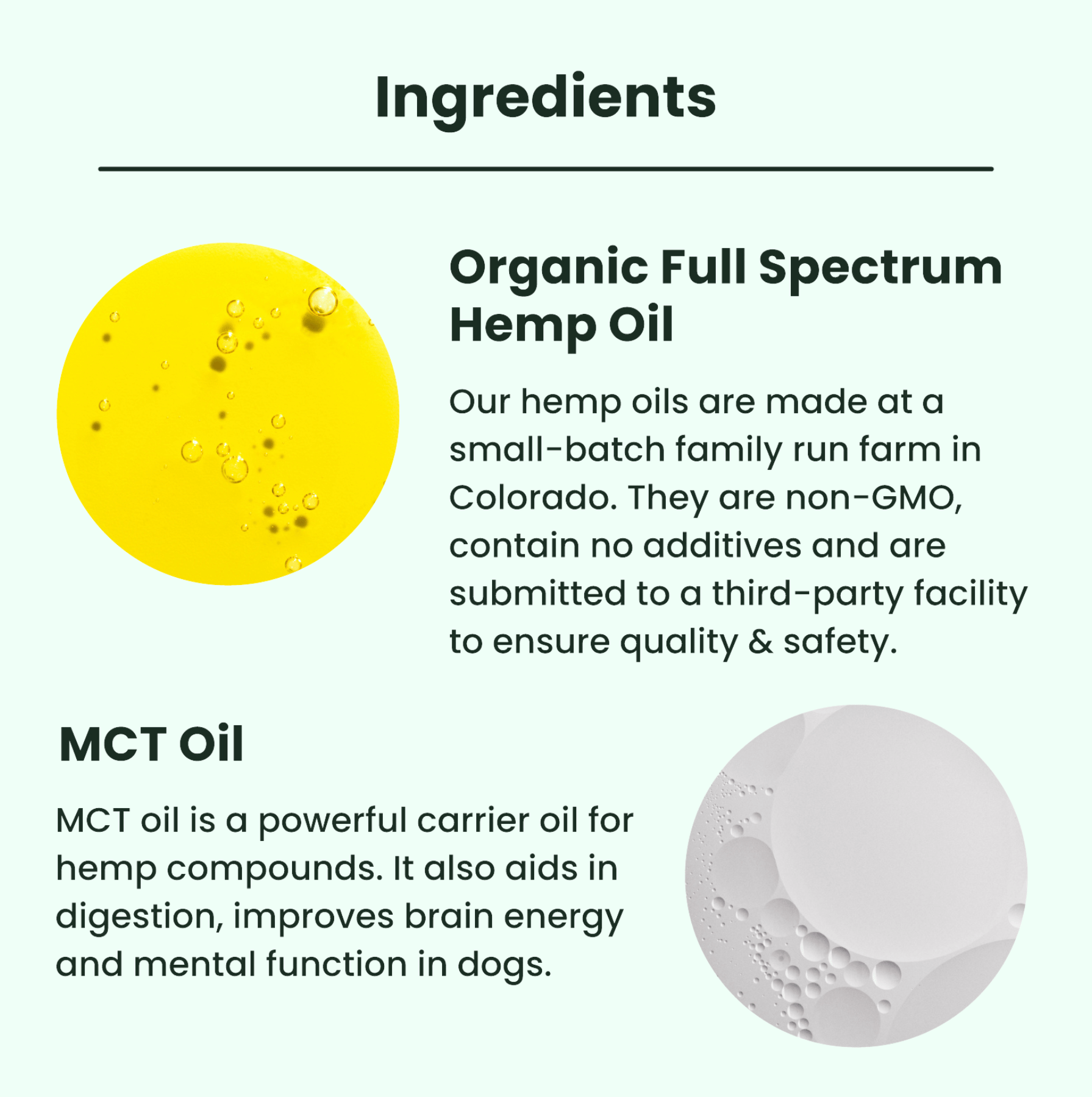
Full spectrum hemp extract preserves the full range of naturally occurring compounds found in the hemp plant. These compounds interact with each other and with the body in ways that a single isolated molecule cannot replicate. Understanding what those compounds are is the foundation for understanding why the format matters.
Cannabinoids Beyond CBD
Hemp contains dozens of cannabinoids in addition to CBD. Full spectrum extracts retain compounds including cannabigerol (CBG), cannabinol (CBN), and cannabichromene (CBC), each of which interacts with the endocannabinoid system through its own distinct pathways. Full spectrum products also contain trace amounts of tetrahydrocannabinol (THC) — typically at or below 0.3% in compliant hemp-derived products, a concentration far too low to produce psychoactive effects in dogs. Each of these compounds adds to a profile that isolate simply lacks.
Terpenes
Terpenes are aromatic compounds found throughout the plant world. Hemp contains a broad spectrum of them, including myrcene, linalool, and beta-caryophyllene. These aren't purely cosmetic — several terpenes interact with the same receptors involved in endocannabinoid signaling. Beta-caryophyllene, for example, binds directly to CB2 receptors and is classified by some researchers as a dietary cannabinoid. Terpenes are stripped out entirely during the isolate production process.
Flavonoids
Flavonoids are phytonutrients found widely in plants and foods. Hemp contains several unique flavonoids — called cannaflavins — not found in other species. Research into their specific contributions is still early, but they are part of the full-plant extract profile that whole-plant hemp products preserve and isolate discards.
The Dose-Response Problem With Isolate
One of the most significant findings in hemp research came from a 2015 study by Gallily, Yekhtin, and Hanus, published in the journal Pharmacology & Pharmacy. The study compared CBD isolate directly against a whole-plant CBD-rich cannabis extract. The results were striking.
CBD isolate produced what researchers described as a bell-shaped dose-response curve. In practical terms, this means the compound produced increasing effects up to a certain dose — and then effectiveness declined as the dose increased further. The effective window was narrow. Too little and you see nothing; too much and the benefit diminishes. For anyone trying to find the right dose for a dog, this creates a significant and often invisible problem.
The whole-plant extract in the same study did not exhibit this bell curve. Its dose-response relationship was more linear — higher doses continued to produce greater effects within a wider range. The researchers concluded that the whole-plant extract overcame the dose-response limitations of CBD isolate and attributed this directly to the synergistic presence of multiple plant compounds working together. This is the core scientific basis for what's known as the entourage effect.
This study was conducted in a mouse model rather than dogs specifically, and that limitation is worth acknowledging. But it remains one of the most carefully designed direct comparisons of these two formats in the published literature, and its findings are consistent with what integrative veterinary practitioners observe clinically.
Why "Cheap CBD" Is Usually an Isolate Problem
Producing CBD isolate is substantially cheaper than producing a high-quality full spectrum extract. The isolation process is simpler, easier to standardize, and strips out the plant compounds that require more careful preservation. The cost difference is real — which is why many budget pet CBD products are isolate-based, often without advertising it prominently.
This matters because when dog owners say "I tried CBD and it didn't work," there's a reasonable chance they used an isolate product without knowing it. The dose-response problem then compounds this: a dog who might respond well to a full spectrum product could show no response to an isolate product, particularly if the dose fell outside that narrow effective window. The experience reinforces the belief that CBD doesn't work — when the more accurate conclusion is that that particular format didn't work.
The distinction isn't a higher dose of the same thing. It's a fundamentally different product.
The THC Question in Full Spectrum Products
Concern about THC in full spectrum hemp products is understandable. THC is toxic to dogs at meaningful doses, and cannabis toxicity is a documented veterinary issue. This is worth addressing directly.
Hemp-derived full spectrum products are required to contain 0.3% THC or less by dry weight under federal law. At this concentration, a standard serving of hemp oil contains a fraction of a milligram of THC — orders of magnitude below any dose that produces adverse effects in dogs. Integrative veterinary practitioners who work with hemp products regularly consider the risk profile of compliant, tested full spectrum hemp oil to be negligible at appropriate serving sizes.
Confirming this through a third-party certificate of analysis is the right approach. A COA from an independent lab will show actual measured THC content — not just a label claim. If a product doesn't have a publicly available third-party COA, that gap is more concerning than the THC question itself.
How to Know What Format You're Actually Buying
Labeling on pet CBD products is inconsistent. Here's what to look for:
- Full spectrum: The label will typically say "full spectrum" or "whole plant extract." A third-party COA should show CBD as the dominant cannabinoid alongside detectable levels of minor cannabinoids such as CBG, CBC, or CBN, with THC at or below 0.3%.
- Broad spectrum: Similar to full spectrum but with THC removed through additional processing. The COA will show multiple cannabinoids with no detectable THC. The synergistic compounds are partially preserved.
- Isolate: The COA will show CBD at 99%+ purity. All other cannabinoids listed as not detected. No terpene or minor cannabinoid profile.
The cannabinoid panel on a COA is more reliable than the label. Some products use terms like "hemp extract" or "phytocannabinoid-rich hemp oil" without specifying format. Understanding how to read a certificate of analysis is the fastest way to cut through ambiguous labeling.
What the Research Suggests as a Starting Point
The available evidence — particularly the Gallily study and subsequent work on what researchers call the entourage effect — points consistently toward full spectrum formats as the more effective option for most dogs. This isn't a marketing conclusion. It comes from the observed difference in dose-response behavior between isolate and whole-plant extracts, and from the pharmacological activity of the minor cannabinoids and terpenes that full spectrum products preserve.
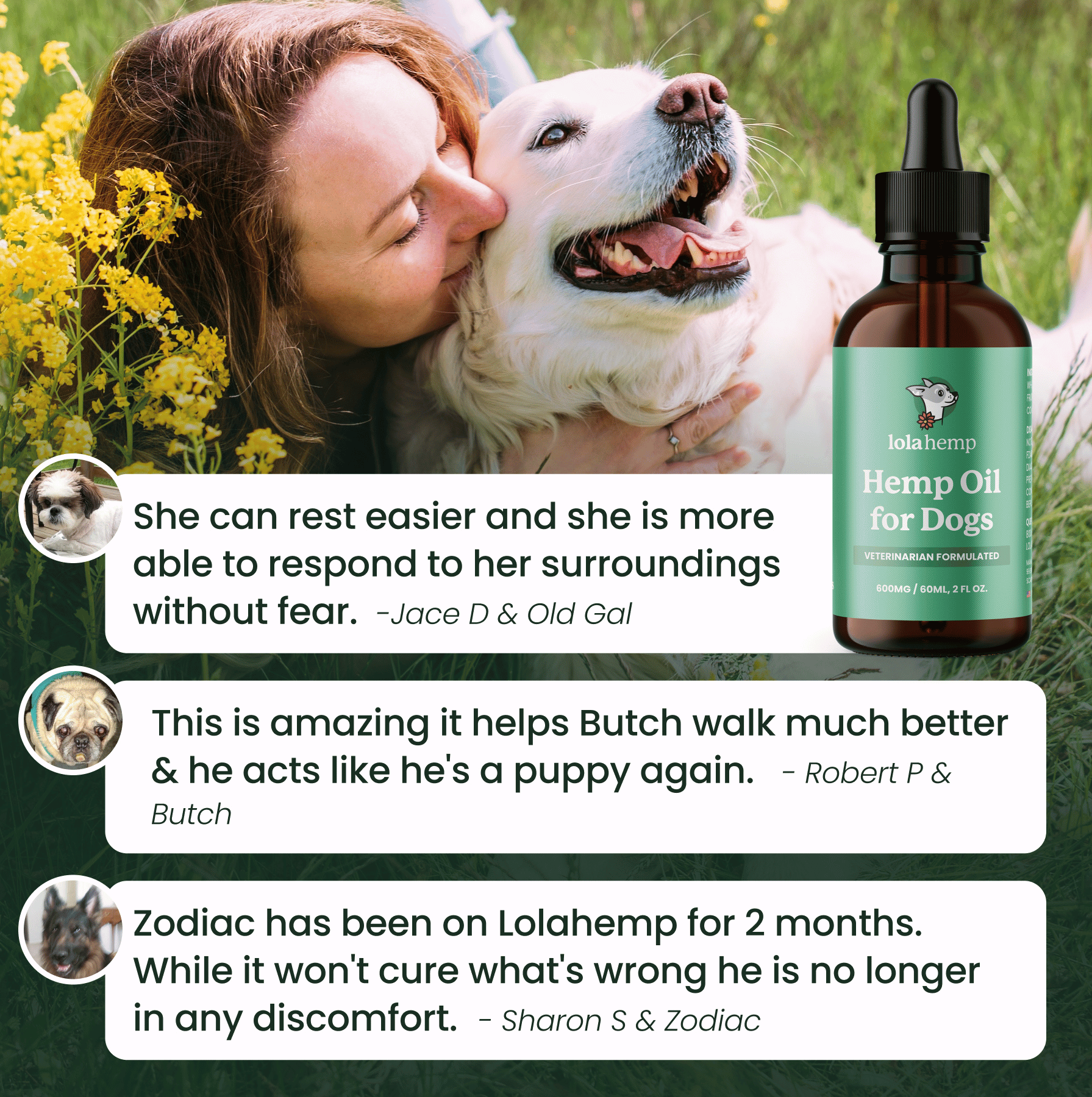
Lolahemp's hemp oil is formulated as a full spectrum product, meaning it retains the full range of naturally occurring cannabinoids, terpenes, and plant compounds from hemp rather than isolating a single molecule. CBD interacts with the endocannabinoid system, which plays a role in supporting normal body function. For dogs whose owners are focused on supporting a calm, settled state during everyday stressors, Lolahemp's calming supplements are formulated to help maintain calmness and support a normal, relaxed disposition in dogs.
Frequently Asked Questions
What is the difference between CBD isolate and full spectrum hemp oil for dogs?
CBD isolate contains only purified cannabidiol with all other plant compounds removed during extraction. Full spectrum hemp oil retains the full range of naturally occurring cannabinoids, terpenes, and flavonoids from the hemp plant. These additional compounds are thought to interact synergistically with CBD in what researchers call the entourage effect, producing a more predictable and broader dose-response than isolate alone.
Why does CBD isolate have a bell-shaped dose-response curve?
A 2015 study by Gallily, Yekhtin, and Hanus found that CBD isolate produced a bell-shaped dose-response pattern — effective within a narrow dose range, then less effective as doses increased further. The researchers found that a whole-plant extract did not exhibit this bell curve, and attributed the difference to the presence of multiple plant compounds working together. The narrow effective window of isolate makes it significantly harder to find and maintain an effective dose.
Is full spectrum hemp safe for dogs given that it contains THC?
Hemp-derived full spectrum products contain 0.3% THC or less, which amounts to a fraction of a milligram per standard serving — far below concentrations that produce adverse effects in dogs. Verifying THC content through a third-party certificate of analysis is the recommended step before using any full spectrum product. If you have concerns specific to your dog's health history, speaking with a veterinarian familiar with hemp supplementation is appropriate.
How do I know if a pet CBD product is isolate or full spectrum?
The most reliable method is reviewing the product's third-party certificate of analysis rather than relying on label language alone. A full spectrum product will show CBD alongside detectable levels of minor cannabinoids such as CBG, CBC, and CBN, with THC at or below 0.3%. An isolate will show CBD at near 99% purity with all other cannabinoids listed as not detected.
What does the research say about full spectrum vs CBD isolate for dogs?
Most comparative research has been conducted in rodent and cell models rather than dogs specifically. The most frequently cited study — Gallily et al. (2015) — found that a whole-plant CBD-rich extract outperformed CBD isolate in terms of dose-response predictability and efficacy range. While dog-specific clinical trials are limited, the endocannabinoid system is structurally similar across mammals, and many integrative veterinary practitioners apply the same full spectrum preference to canine hemp use based on the available evidence.


