

It's somewhere between midnight and 4am. Your rescue dog won't stop pacing, whining, or scratching at the crate. You're exhausted, possibly crying, and Googling things you'll be embarrassed about tomorrow. This post is for you, right now.
Nighttime is hard for new rescue dogs. It's when the overwhelm of the day settles in, the distractions disappear, and they're left alone with the unfamiliarity of everything. It usually gets better. Here's how to get through the first week.
Related product




Why Rescue Dogs Struggle to Settle at Night
During the day, there's movement, noise, and stimulation to anchor to. At night, there's nothing — and for a dog whose nervous system is already on high alert, that silence can actually make things worse, not better.
A few things are typically driving the nighttime restlessness:
- They don't know yet that you're coming back. Every time you disappear behind a door, they have no way of knowing it's not permanent.
- The environment is completely unfamiliar. New smells, new sounds, a new structure to navigate in the dark.
- Shelter life disrupted their sleep patterns. Many rescue dogs come from environments with noise and light around the clock — adjusting to a quiet house takes time.
- They may be grieving. Dogs grieve the loss of familiar people and places. That often surfaces at night.
What You're Likely Seeing — and What It Means
Normal first-week behavior:
- Whining or crying, especially in the first few nights
- Pacing or inability to settle in one spot
- Waking frequently and seeming disoriented
- Wanting to be physically close to you or at your bedroom door
Signs that something more may be going on:
- Panicked, frantic behavior that escalates rather than ebbs
- Self-injury from attempting to escape a crate or confined space
- Complete inability to settle even with you present
If it's the latter, it may be early signs of separation anxiety rather than ordinary adjustment stress — worth reading about separately as the approach is different.
First Week Survival: What Actually Helps
- Put the crate or bed in your bedroom. At least for the first week. Physical proximity to you is the single biggest settling factor for most dogs. You can move them gradually once they've established some security.
- Use a worn piece of your clothing. Put a t-shirt you've slept in with them. Your scent is genuinely calming for a dog trying to orient to a new person.
- Try a white noise machine or fan. Softening the silence helps. It also buffers the unpredictable sounds of a new house that can trigger alertness.
- Give a long-lasting chew before bed. A bully stick or similar chew occupies the mind and creates a positive association with settling. It also releases calming hormones through the act of chewing.
- Keep nighttime interactions low-key. If you need to respond to your dog at night, do it calmly and briefly. Long soothing sessions can inadvertently reward and extend the waking.
- Cover the crate if you're using one. A covered crate feels more den-like and less exposed. Many dogs settle faster with the visual stimulation removed.
- Establish a consistent pre-bed routine. A short walk, a chew, lights down, same location every night. Routine is safety — and the earlier you establish it, the faster the nervous system learns what's coming.
When It Persists Past the First Week
Most dogs show meaningful improvement in nighttime settling within seven to fourteen days. If yours isn't, a few things are worth looking at:
- Is the sleeping arrangement creating more anxiety than it's resolving? Some dogs do better closer to you; some get more worked up when they can hear but not reach you.
- Is your dog getting enough physical exercise during the day? Under-stimulated dogs have a harder time shutting down at night.
- Is the nighttime restlessness part of a broader pattern of separation distress that shows up during the day too? If so, that's a different issue — and a bigger one — than ordinary adjustment.
The emotional weight of broken sleep night after night is real. If you're struggling with more than just the logistics, what you're feeling has a name — and it's more common than anyone talks about.
Supporting Nighttime Calm With Supplements
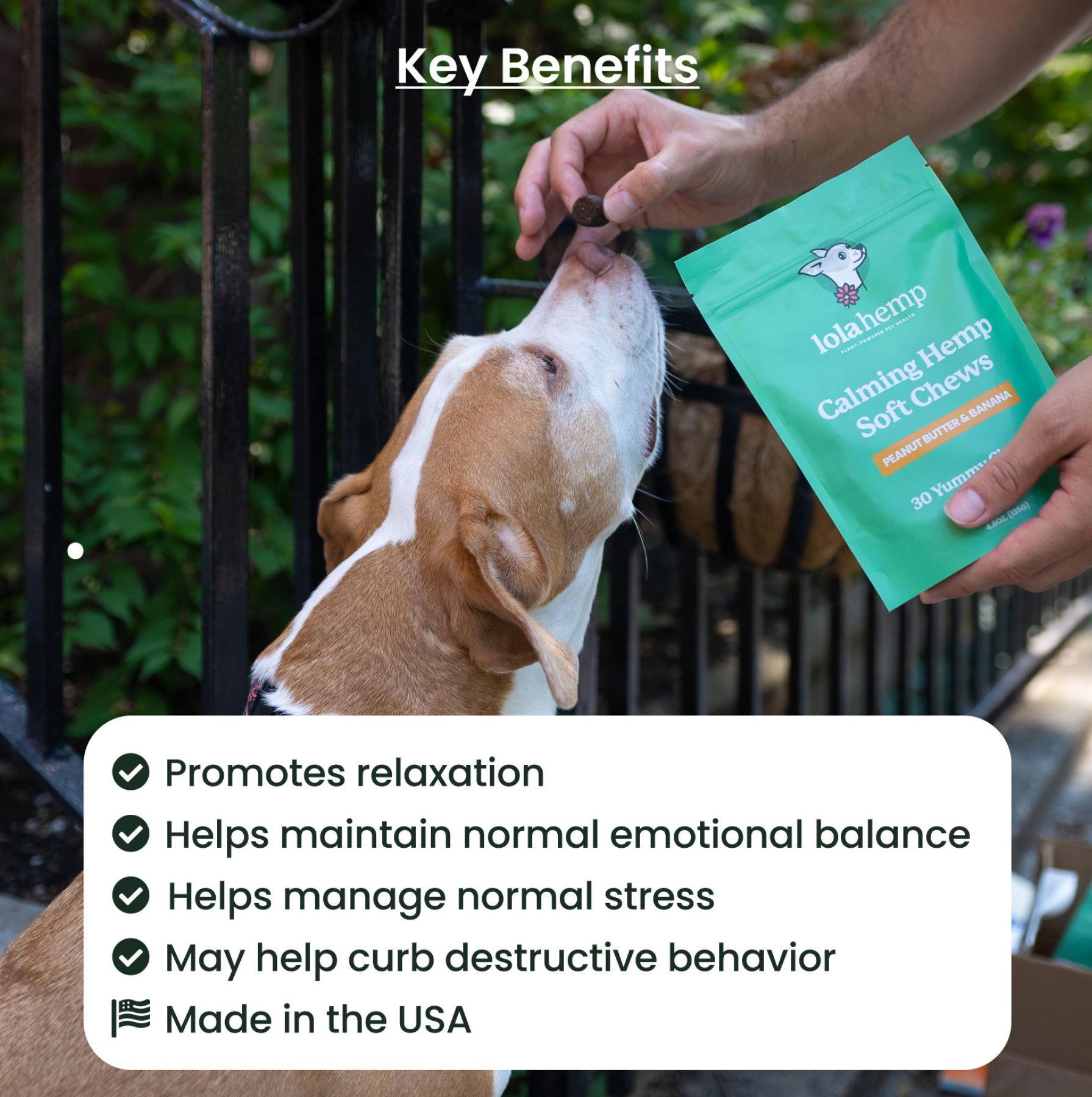
Some owners find that a calming supplement given in the evening helps their dog reach a more settled baseline at bedtime. Lolahemp's calming supplements are formulated to help maintain calmness and support a normal, relaxed disposition in dogs — and for dogs who are wound up from the day's stimulation, that support can make the difference between a settled night and another long one.
Not a fix on its own, but a useful complement to the routine-building work above.
Frequently Asked Questions
How long does it take for a rescue dog to sleep through the night? Most dogs improve significantly within one to two weeks, with many settling into a normal sleep pattern by the end of the first month. Dogs with more significant anxiety histories may take longer.
Should I let my rescue dog sleep in my bed? There's no single right answer. Bed-sharing can help with bonding and settling in the short term, but for dogs showing signs of separation anxiety or velcro behavior, it can deepen dependence. Consider your dog's specific patterns — and your own sleep — when deciding.
Is it okay to ignore nighttime whining? In the first few days, ignoring a dog who is overwhelmed and disoriented can increase distress. A calm, brief response is usually better than none. Once your dog is settled into the routine and the whining becomes habitual rather than stress-based, a more structured approach makes sense.
My rescue dog wakes up every few hours — is that normal? Yes, especially in the first one to two weeks. Fragmented sleep is common in newly adopted dogs whose routines and nervous systems are still calibrating. Consistent routine and physical proximity usually resolve it.
What if my dog is destructive at night when I'm asleep? Nighttime destruction when the dog is unsupervised is often a sign of separation anxiety rather than ordinary adjustment. Management — confining to a safe space — is the short-term solution, but understanding what's driving the behavior matters for the longer-term approach.


